
KUCI / Tiles & Slabs
How to Order Bookmatched Tiles and Large Slab Layouts
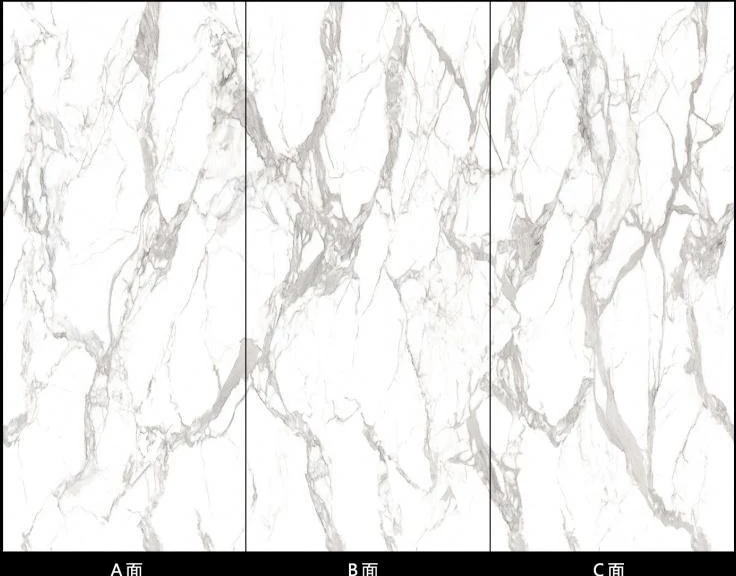
Order bookmatched tiles from an approved elevation, with face codes, orientation, cuts and spare pieces. Avoid buying enough area but the wrong pattern set.
Before you start
- Approve the face arrangement before calculating the order quantity.
- Keep face codes and orientation visible on the elevation and packing list.
- Allow for actual cuts and useful replacement pieces, not only total area.
Bookmatched tiles and continuous vein slabs should be ordered from an approved layout, not only a total square metre figure. The design depends on which faces arrive, how they are oriented and where cuts occur. Buying enough area does not necessarily provide the pieces needed to reproduce a showroom wall.
For an overseas project, correcting a missing face can be more disruptive than replacing an ordinary tile. Resolve the pattern and cutting plan before production or stock allocation.
Confirm what the pattern description means
Ask the supplier to show the full face set. Bookmatching usually describes a mirrored relationship between adjacent faces. Other collections use directional veins, repeating sequences or several different faces without a continuous pattern. Marketing names alone may not reveal how a particular collection works.
Request images of each face with its identification code and orientation. Confirm whether the displayed arrangement requires a fixed set and whether individual replacement faces are available. A single attractive product image is not a complete installation reference.
Draw the finished wall before calculating quantities
Prepare an elevation showing the finished width and height, visible boundaries, joints, sockets, niches, doors and other interruptions. Place the actual face images on that elevation. Review where the main veins cross joints and whether important features disappear into a cutout.
For example, a four face feature wall might lose its intended symmetry if the installer starts from one corner and cuts the final panel to fit. Centering the approved composition first may produce a better result, but it changes the required cuts and spare material.
Calculate whole pieces and useful offcuts
List the number of complete pieces required for each face. Then identify which offcuts can be reused without breaking the pattern or creating unsuitable pieces. Calculate the order from that cutting schedule and the supplier's pack quantities.
Keep cutting allowance, transit spares and future maintenance stock separate. The right allowance depends on the layout. A spare of face A may not replace a damaged face D, even when the dimensions and collection name are the same.
Verify the product and installation system
Large size and a pale body do not establish a product's classification or suitability. Ask for the manufacturer's technical information, declared applications and fabrication instructions. TCNA defines porcelain by tested water absorption and advises checking the manufacturer's area of use rather than assuming every product suits every location. See TCNA guidance on porcelain and non porcelain tile.
The installer should confirm substrate preparation, adhesive compatibility, support and handling equipment for the specified product. Do not substitute a generic adhesive recipe for the manufacturer's system.
Deliver the layout with the shipment
Mark the approved face references on the order and packing documents. Give the installer a numbered layout, orientation arrows and the final revision date. Inspect the pieces before cutting, and review a dry arrangement where practical.
If a substitution is needed, approve the revised visual layout first. Similar color is not enough to confirm that the replacement has a compatible vein direction.
Is bookmatching the same as random face variation?
No. Random face variation provides visual variety, while bookmatching relies on a planned relationship between faces. Confirm the actual set before ordering.
What should I send for a layout quotation?
Send the wall elevation, finished dimensions, opening positions and a reference image of the intended composition. Ask for the face schedule and cutting assumptions to be returned with the quotation.
What to include in the layout approval
- Finished wall width and height, joints, returns and all openings.
- A code and orientation arrow for every full face and cut piece.
- A cutting plan showing which offcuts can actually be reused.
- The agreed replacement faces, batch information and package labels.
- Written confirmation that the supplied face set can reproduce the approved arrangement.
Explore products for your project
Bring the right details to your enquiry
Share your project location, plans and the product decisions you are working through.
Discuss your project ↗